
My practice begins with a personal history and opens into a civilisational question: what happens to a culture when it is separated from its own memory?
Egypt is not, for me, a chosen subject. It is part of my family's story — a presence I have carried and, over years of research and direct encounter, learned to investigate through painting. I have spent time in necropoles and temples, studied objects across museum collections in Egypt and abroad, and traced the paths that artefacts have travelled away from the places that first gave them meaning.
This investigation unfolds across three interconnected bodies of work.
Echoes of Displaced Antiquities examines objects removed from Egypt and now held in foreign collections. I approach each artefact not as a museum exhibit but as a presence still shaped by what it lost — its architectural context, its ritual function, its homeland. My position is clear: these objects belong to Egypt. But the work itself moves beyond statement into research, asking how displacement changes an object, how absence leaves a mark, and what it means for a civilisation to exist without its own image.
Strata approaches Egypt from two directions simultaneously — from above, where the Nile reads as a topographic body, a living map of a civilisation written into the land; and from below, where texture stands for the buried cities and layered histories that remain beneath the surface. Onto this ground I place scenes drawn from tomb and temple walls: birds, fish, animals, moments of daily life preserved in paint for thousands of years and still, I believe, in circulation.
Heritage of Egypt turns toward what remains inside the country — the vast, largely unseen depth of objects and images that exist beyond the handful of icons the world has chosen to recognise. Egypt holds more than the world knows. This body of work is an act of looking more carefully.
Across all three, I work with oil, acrylic, texture paste and incision — building surfaces where ancient material and contemporary language are physically present together. The canvas is not an illustration of history. It is a site of investigation, where the question of what belongs where, and to whom, remains unresolved and alive.
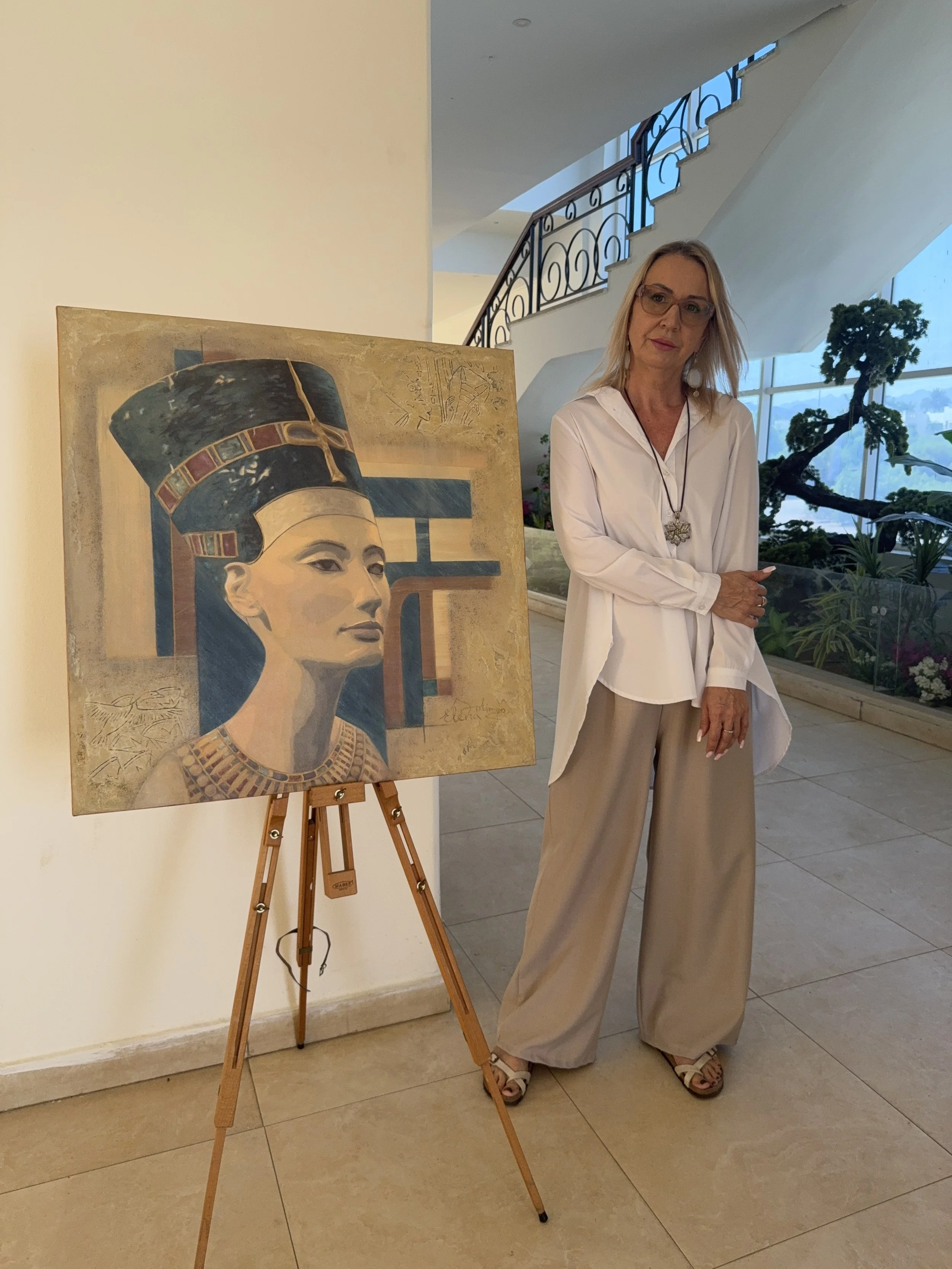
The work is grounded in direct research: fieldwork at Saqqara, study at the Egyptian Museum Cairo, engagement with published Egyptological scholarship, and close attention to the specific histories of displacement that each artefact carries.
SELECTED EXHIBITIONS
2025 KHUTAWAT — The Arabian Art Exhibition · Bhavan Gallery, London
2024 Venice International Art Fair · Palazzo Albrizzi-Capello, Venice
2024 تراثنا (Our Heritage) · Citadel of Saladin, Cairo · Award: Dr. Zahi Hawass
2024 Art Exhibition · Prince Taz Palace, Cairo · First Prize: Dr. Mustafa El-Waziri
2024 Garden on the Nile · Russian Culture Center, Cairo
2024 Wgood Forum · Religions Complex, Cairo · 2nd Place
2023 Kayan · Beit Al-Suhaimi, Cairo · 2nd Place: Major General Tarek Mahdy
2023 Solo Exhibition Roots · Russian Culture Center, Cairo
2023 Art Symposium · Tunisia